
Home Again
What it Means to Leave the Frontier Behind

Robert Picard: “This is going to be with you a long time, Jean-Luc. A long time. You have to learn to live with it. You have a simple choice now - live with it below the sea, with Louis, or above the clouds, with the Enterprise.”

Captain Jean-Luc Picard
Hello again! While this isn’t an official end to our semi-official series on the frontier in science fiction, I feel that Clay’s piece from last week offers an opportunity to explore what the appeal of the frontier might say about the internal and cultural impulses that drive us beyond familiar shores, and what it might mean to stay within familiar borders instead. As always, spoilers lie ahead; if you’re desperately holding out on Star Trek: The Next Generation Seasons 3 and 4 for whatever reason, proceed with caution.
Season 3 of Star Trek: TNG concludes with Captain Picard’s capture and conversion by the Borg, a mysterious cybernetic species whose only stated goals are to “assimilate” other lifeforms and turn them into more Borg, “adding [their] uniqueness” to the Borg’s own consciousness. During the Borg’s devastating attack on the Federation’s fleet, Picard is taken by the Borg and transformed into “Locutus,” an avatar of the Borg intended to provide the Federation with a more palatable face for the eventual assimilation of Earth. The Borg have, to everyone’s knowledge, fully turned humanity’s most talented starship captain into an unfeeling organic machine.
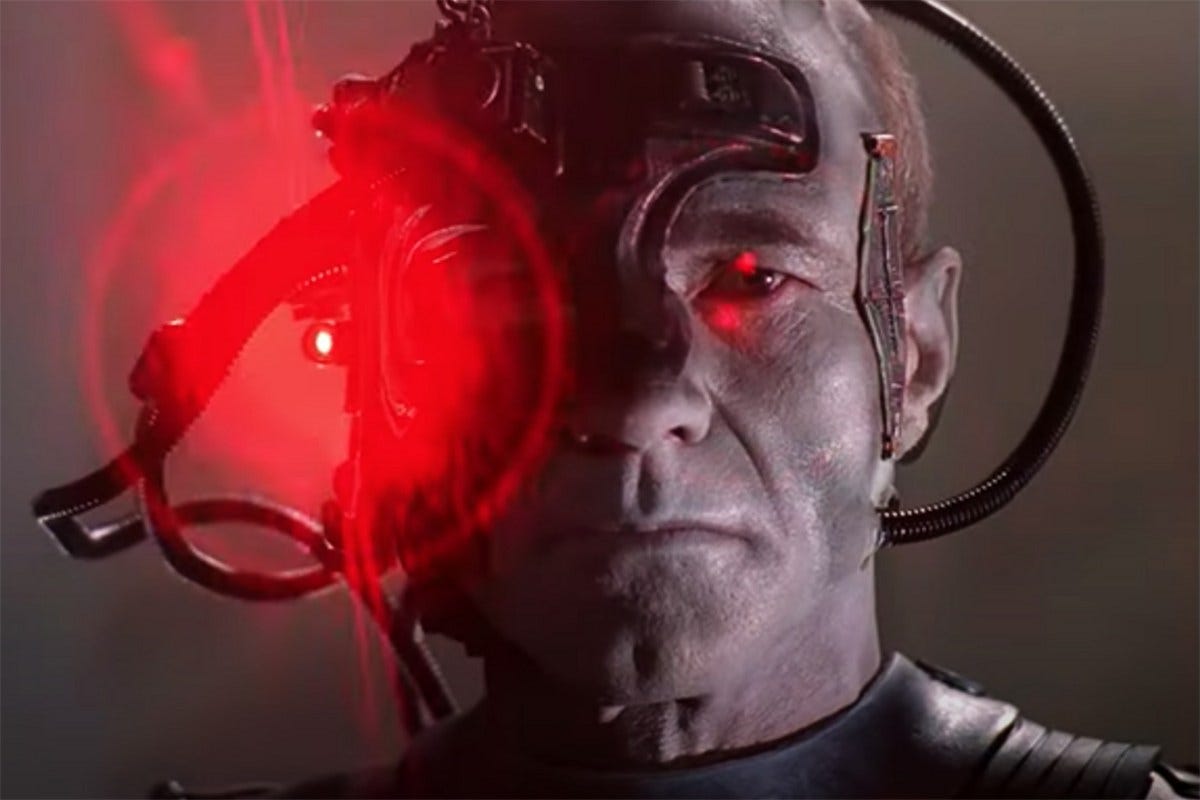
Picard as Locutus
It should come as no surprise that Season 4 of TNG opens with Picard’s rescue and the Borg’s defeat by the ever-ingenious Enterprise crew, as it would have been exceedingly bold (or rash) for TNG to kill off Picard, much less the Federation wholesale, just as the series was hitting popular appeal. What is somewhat surprising is how well TNG handles the personal aftermath of Picard’s experiences with the Borg. In a series known for picking up and dropping storylines like mismatched socks, Season 4, Episode 2 (“Family”) focuses in large part on the felt effects of Picard’s experiences as Locutus.
Towards the end of “Family,” Jean-Luc ends up fighting in the mud with his stubbornly traditionalist brother Robert, the pair seemingly having come to blows over petty childhood rivalries they’ve unearthed together. As the brothers eventually separate in breathless laughter, Jean-Luc cracks; his laughs turn to sobs as he fully and finally expresses the pain he felt at being the Borg’s instrument of destruction. “They used me… they used me to kill and destroy, and I couldn’t stop them! I wasn’t good enough, I wasn’t strong enough to stop them! I should have been…” Robert pauses and replies, “So. My brother is a human being, after all.”
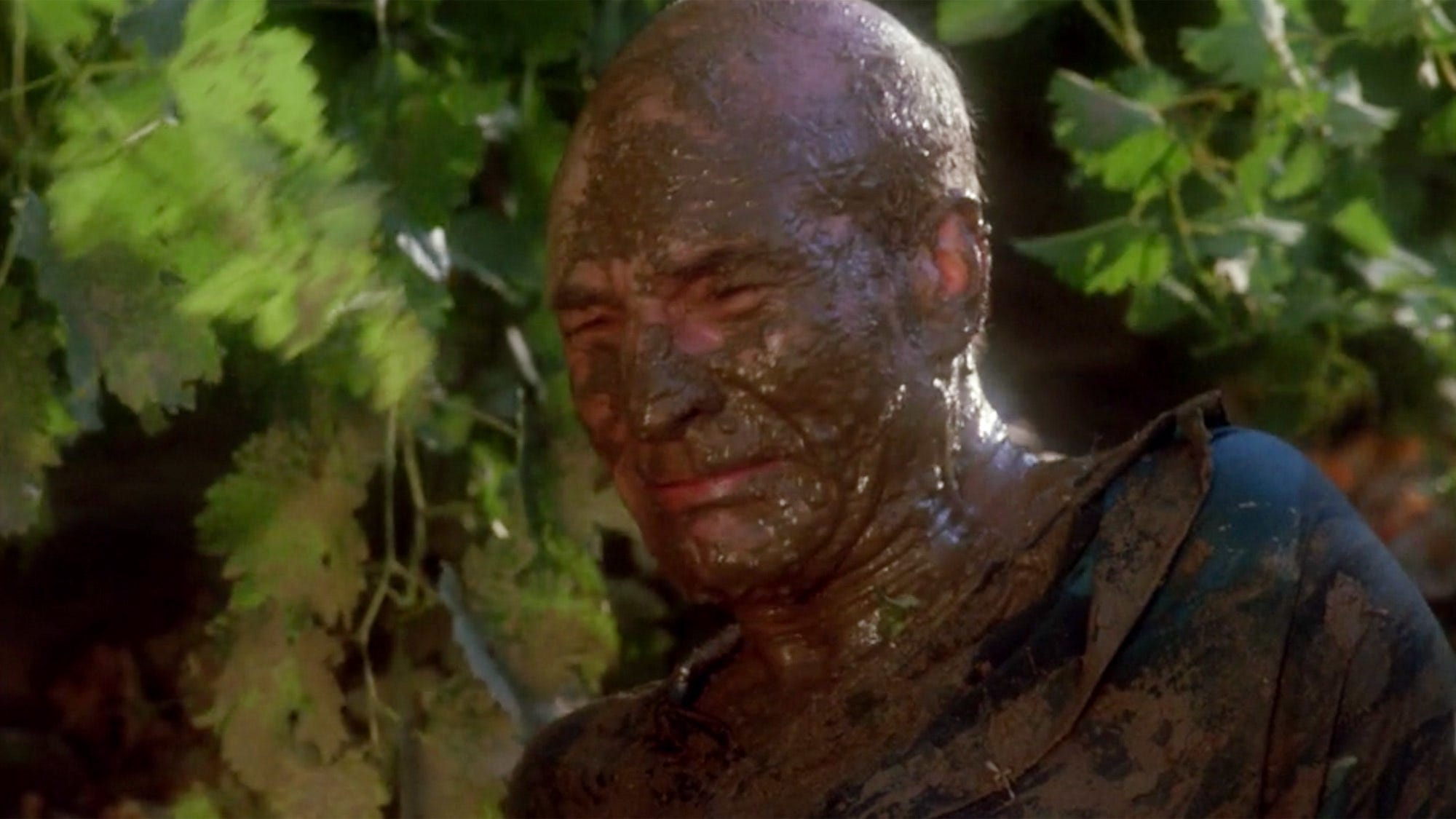
The Star-Captain in the mud
Framing Robert and Jean-Luc’s mud-spattered heart-to-heart is a decision, the one Robert mentions in the quote I used to open this entry. Following his time under Borg captivity, Capt. Picard is unsure whether he is suited (or wants) to continue command of the Enterprise. Jean-Luc entertains the possibility of taking a job on Earth working to create underwater cities, a venture which (somewhat ironically) would constitute a new frontier for a man accustomed to traversing unexplored stars. While Robert does not push Jean-Luc in any particular direction, he does remind his brother that, whichever choice he takes, Jean-Luc remains Jean-Luc. Entering a new frontier does not make one into a new person; a new frontier merely provides a new backdrop against which humans will still be (must still be) humans.
I don’t think it would be breaking especially new ground to say that humans have not handled custodianship of our planet well. Whether or not the damage we’ve collectively done to our biosphere is a death-sentence for our species remains an open question, though for my own part I remain darkly optimistic; humanity is a hard weed to kill off, thus far at any rate. Regardless, the undercurrent of awareness that we’ve royally screwed things up here has led some to envision new frontiers as an opportunity to start over again, to do it right this time and avoid putting ourselves in this position down the road. What these imaginings ignore, however, is that wherever we go, however far away or unfamiliar it may be, humans will remain humans there, too. To me, it smacks of naivete (if not outright conceit) to presume that a change of venue will somehow moderate our destructive tendencies; if anything, our headlong rush into outer space proves our willingness to stamp our footprints onto whatever ground will hold us.
As Clay drove home last week, the appeal of the frontier lies in part with our belief that frontiers exist as spaces in which we are entitled to play, whether for our own betterment or simply for our amusement. What such a framing obscures/ignores is the brute fact that the spaces we call “frontiers” exist before, after, and without us. Humans and animals inhabited what we call the “New World” for tens of thousands of years before anyone from the “outside” knew they were there; the arrival of outsiders did not suddenly transform or erase those lives and experiences into a new space simply because the land was now a “frontier” to someone. Wherever we go, whatever or whomever we find there, we will still have to live with ourselves when we arrive. If we’ve shown thus far that we struggle to do that within the confines of our own planet, why should we do any better on an interstellar scale? Perhaps, as Capt. Picard ultimately decides, we are better served by living with ourselves at home (even if that home is a starship) than we are by carrying our unresolved selves into uncharted waters. After all, it’s a lot easier to work through oneself when you at least know where everything is kept.
“No matter where you go … there you are.”
- Buckaroo Banzai